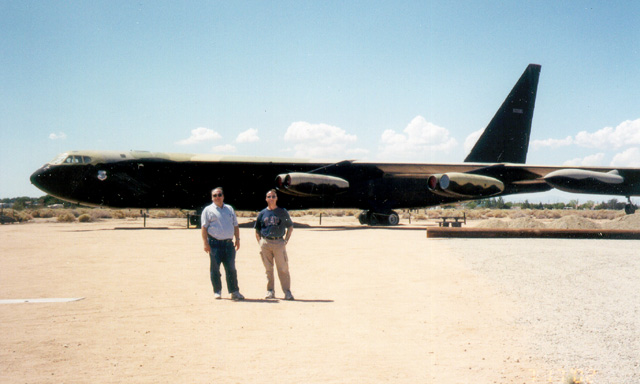
B-52 Development History:
From A to H
The general layout of the two B-52 prototypes, the XB-52 and the YB-52, was similar to that of the B-47. Boeing engineers retained the 35-degree swept wing, pylon-mounted engines, braking parachute, bubble canopy and bicycle-type landing gear.
A notable difference was the use of four separate and steerable landing-gear units. This interesting capability allowed B-52 pilots to align the landing gear with the center of the runway while crabbing the aircraft into the wind during crosswind landings.
Another innovation was the use of a completely moveable horizontal tail, instead of conventional elevators, for pitch control. This system was standard for jet fighters of the period, but had not been used on jet bombers.
B-52A: Side-by-side
Seating
By the time the B-52A made
its first flight in 1954, a more traditional cockpit with side-by-side seating
had replaced the prototypes' bubble canopy.
The bombardier and the radar operator were located in a compartment below and just aft of the flight deck. The gunner, in charge of four .50-caliber machine guns, operated from a pressurized compartment in the tail.
The B-52A carried 35,600 gallons of fuel housed in flexible bladders inside the wing and along the top of the fuselage. In addition, the B-52A also carried two 1,000-gallon drop tanks under each wing.
B-52B: 1st
Production Stratofortress
The B-52A was followed by the
B-52B, with increased gross weight and larger jet engines. The B-52B was the
first production version of the Stratofortress because the three B-52As were
primarily used as flight-test aircraft.
The B-52B entered service with the U.S. Air Force's Strategic Air Command on June 29, 1955, with the 93rd Bomb Wing at Castle Air Force Base, California.
With photographic reconnaissance or electronic capsules installed in their bomb bays, 27 of the 50 B-52Bs built were designated RB-52Bs.
B-52C and D: More
Weight, Range
Next off the line were 35
B-52Cs. Further improvements resulted in a higher gross weight of 450,000 pounds
and unrefueled range extended by a total fuel capacity of 41,700 gallons.
The B-52D, built in both the Seattle and Wichita plants, made its first flight in 1956. The B-52D was essentially the B-52C without the alternative reconnaissance capsule feature.
A total of
B-52E and F: Boom
Extends Range
One hundred B-52Es and 89
B-52Fs followed the Ds. The Es and Fs were exclusively long-range, heavy
bombers. Equipped with the Boeing-developed flying boom system for in-flight
refueling, they had virtually unlimited range.
The B-52E first flew in 1957, with improved bombing, navigation and electronic systems. It was the least expensive of the series, costing just more than $6 million per airplane. At the time, the B-52 was criticized for its high cost.
Seattle delivered 42 B-52Es, while 58 came from Wichita.
The B-52F, the last model before the bomber went through a major redesign, used 13,750 pound-thrust Pratt & Whitney J57-43W turbojet engines.
Seattle production of B-52s ended in 1958, when the last of 44 B-52Fs rolled off the assembly line. However, another 45 B-52Fs were produced in Wichita, where the substantially improved G and H models also were built.
While B-52Cs and Es were phased out during the early 1970s and the Fs in the late 1970s, B-52Ds remained in service until 1983.
B-52G and H:
Redesigned, More Capable
The B-52G and B-52H looked
very similar to earlier Strartofortress models, but they were substantially
different and capable of a variety of new missions.
The B-52G, which made its first flight in 1958, was the first variant to introduce major innovations to the original design.
It had a redesigned wing and a shorter vertical fin. Its internal fuel capacity was increased to 46,000 gallons by using built-in wing tanks rather than the flexible bladders of earlier versions. This gave the B-52Gs a range almost 2,000 miles greater than the first B-52s.
The gunner left his rear compartment and was moved forward to be with the rest of the crew. This was because the tail guns on the B-52G were fired by remote control using a TV link.
While equipped as a standard bomber, the B-52G could carry two North American Aviation AGM-28 Hound Dog supersonic air-to-surface missiles on pylons under each wing. The Hound Dog, capable of streaking several hundred miles to the target on its own inertial guidance system, changed the B-52 into a missile-launch platform. In 1970, the Air Force decided to replace the Hound Dog with the Boeing-developed AGM-69A SRAM, for short-range attack missile.
B-52Gs also carried the McDonnell Aircraft GAM-72 Quail decoy missile, a miniature jet aircraft that could imitate the signature of the B-52 on enemy radars.
In 1985, 30 B-52Gs were modified to carry and launch the McDonnell Douglas AGM-84D Harpoon anti-ship missile.
A total of 193 G models were built, and they remained in service until 1994.
The B-52H first flew in 1961. Incorporating all of the B-52G's improvements, the H was developed specifically to carry four Douglas AGM-87A Skybolt missiles. However, after cancellation of the Skybolt program, the B-52H reverted to carrying AGM-28 Hound Dogs. Like the B-52G, the H was later provided with the SRAM. Later, B-52Gs and Hs were modified to carry Boeing AGM-86B ALCM air launched cruise missiles.
One major advancement for the B-52H was the switch to Pratt & Whitney TF33 turbofan engines. With more than 17,000 pounds of thrust, the turbofans were much more powerful than the turbojets.
For the B-52H, the four .50-caliber machine guns in the tail were replaced with a 20-millimeter six-barrel rotary cannon. Other improvements included more refined electronic defensive and offensive systems, and the ability to fly at extremely low altitudes.
Like the G, all 102 H models were built in Wichita.
The B-52 Today
A total of 744 B-52s were
built by Boeing in all versions between 1952 and 1962. Only the B-52H remains in
service today.
Boeing has made several major modifications to the B-52 since it entered service and will continue to perform additional improvements in the future.
Upgrades have included many new and improved systems that have increased the B-52's flexibility and versatility as a weapons system. Today's B-52s can hit targets anywhere in the world, in all kinds of weather, with pinpoint accuracy.
April 11, 2002